Hoya carnosa Problems and Common Issues Guide
Your Hoya carnosa Problems Solved
Hoya carnosa, also called the Wax Plant, usually gets on with life without much fuss. That makes it all the more frustrating when its thick leaves start wrinkling, turning yellow or falling off and you're not sure what you've done wrong.
The tricky part is that different problems can produce similar symptoms. For example, a thirsty Hoya and one with damaged roots can both have limp leaves, but while the first might need a drink, more water could make things worse for the second. This guide will help you check the likely cause before deciding what to do.
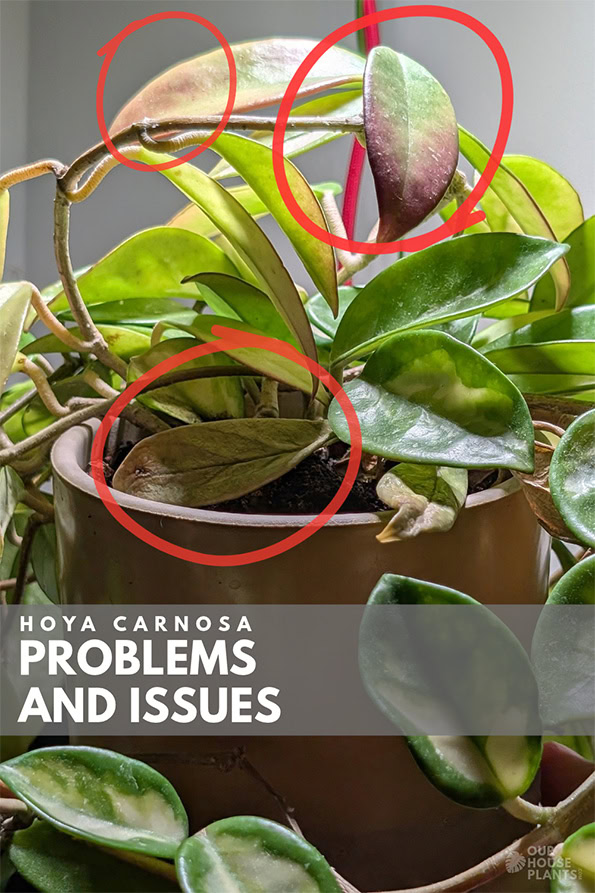
Yellow or wrinkled leaves on your Hoya carnosa? Your Wax Plant could be thirsty, overwatered or dealing with damaged roots. I'll help you work out what's going on and what to do next.
You can jump straight to your plant's symptoms below. If you'd also like a refresher on everyday watering, light and potting mixes, my Hoya carnosa care guide covers those in more detail.
Before you panic: is it actually a problem?
Some things that look unusual on a Hoya are perfectly normal. Before changing its care, check whether you're seeing any of these:
- One older leaf turns yellow, or growth slows in winter.
Hoyas don't keep every leaf forever, and lower light and cooler temperatures during winter can slow growth. If several leaves are yellowing or the plant looks unwell, though, it's worth investigating. - Roots or long bare vines appear along the stems.
Aerial roots can help a Hoya grip a support, while long runners often grow before their leaves appear. Neither means there's anything wrong. - Leaves have silver flecks, creamy areas or pink young growth.
Silver splashes are part of some Hoya carnosa leaf patterns. Variegated varieties can also have cream or white markings and pink new leaves. - Flowers are sticky or an old flower stalk looks woody.
Hoya flowers can produce sticky nectar, and the short flower stalk, or peduncle, can bloom again. Leave the stalk attached after flowering. If you find stickiness elsewhere on the plant, check for pests too.
What's wrong with my Hoya carnosa?
- Yellow leaves
- Wrinkled, shrivelling, soft or drooping leaves
- Root rot and mushy stems: can you save it?
- Brown leaf tips and crispy edges
- Sun stress, bleaching and sunburn
- Leaves falling off
- Not growing, bare vines or new leaves not growing
- Not flowering or blooming
- Flower buds dropping and old flower spurs
- Pests, sticky leaves and white fluff
- Brown or black spots, corky bumps and scarring
Yellow leaves
A yellow leaf isn't a diagnosis on its own so start by checking whether it's just one older leaf or several leaves, then feel the potting mix below the surface. A dry top layer can hide a wet root ball underneath. Once you know the answers, check out the potential causes below.
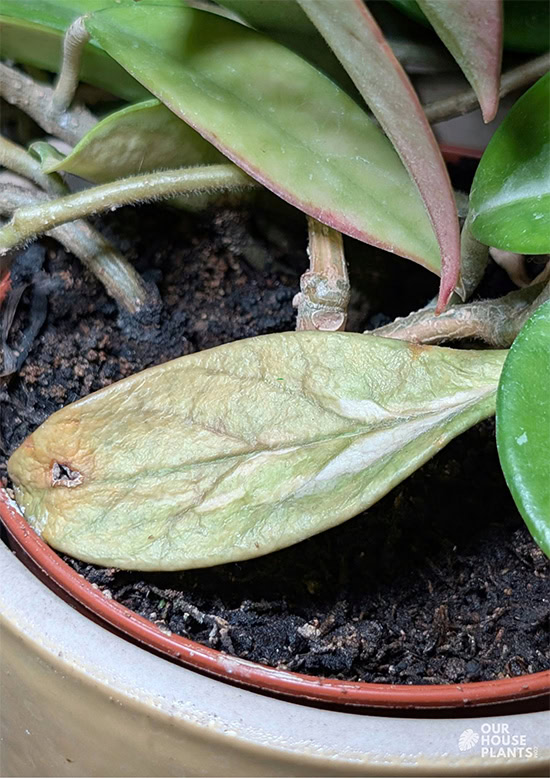
Yellowing leaves like this can have several different causes, you'll need to investigate which is more likely.
What to check and what to do
- Wet compost and several yellowing leaves.
Roots struggle when the mix stays saturated. Empty any standing water from the outer pot and check that drainage holes aren't blocked. If yellowing continues, the plant wilts or the stem base softens, inspect the roots using the root rot advice below. Don't just leave a deteriorating plant sitting in wet compost. - Dry compost with wrinkled or thinning leaves.
Prolonged dryness can also lead to yellowing. Water thoroughly and let the excess drain away. If water runs straight through without wetting the root ball, see the wrinkled-leaf section. - A gloomy position, especially in winter.
Move it into brighter indirect light. Low light also slows water use, so a watering routine that worked by a bright window can become too generous in a darker room. - Cold glass, draughts or a recent change in conditions.
Keep leaves away from cold windowpanes and move the plant out of chilly draughts. A newly purchased plant may need to adjust to different conditions, but don't write off continuing decline as settling in without checking its roots and watering. - One old leaf, with healthy growth elsewhere.
Usually there's nothing to fix. Let it come away easily rather than pulling hard enough to damage the stem.
Once you've found and corrected the cause, you should see fewer leaves turning yellow. Those that have already changed colour won't turn green again, though, and fertiliser won't bring them back, so once they come off easily, just discard them.
Wrinkled, shrivelling, soft or drooping leaves
Mature Hoya carnosa leaves should feel thick and reasonably firm. The name carnosa means fleshy, which is a fitting description of those water-storing leaves. They give the plant a useful reserve, but they don't make it immune to dehydration.
If previously firm leaves become thin, wrinkled or floppy, water isn't reaching them fast enough. Check the compost before adding more water: the cause could be thirst or roots that can no longer take up moisture properly.
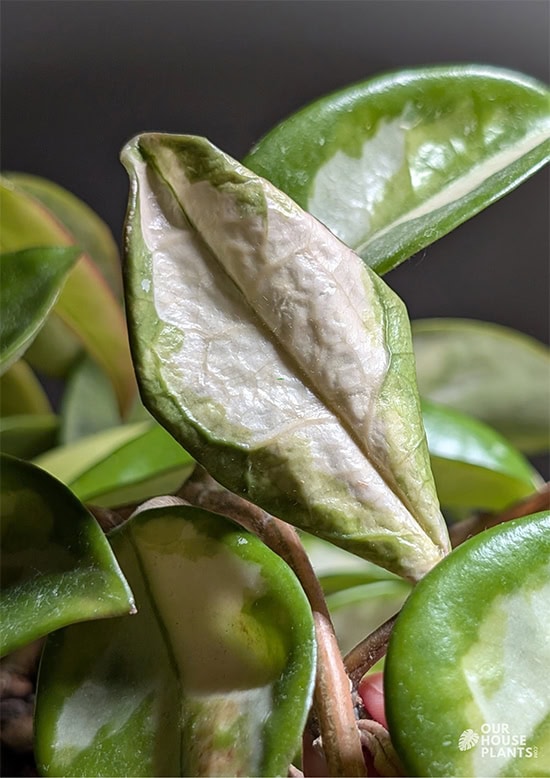
Wrinkled leaves like this are not usual and almost always point to a watering problem (not enough or too much).
If the root ball is dry
Water slowly and thoroughly, allowing excess water to drain. If the mix has shrunk away from the pot and water bypasses it, stand the growing pot in a shallow container of water until the root ball has taken up moisture, then remove it and drain fully. Don't leave it standing in water afterwards.
Check whether the mix dries unusually quickly. A very crowded pot, strong heat or a small amount of compost around the roots can make a plant thirsty again sooner than expected. Move it away from radiators or hot glass rather than trying to compensate with constant little splashes.
When "Wrinkled" isn't a problem
Expanding young leaves are naturally softer than mature ones and could have slight wrinkles. Some varieties like Hoya carnosa 'Krinkle 8' have permanently puckered leaves. Compare your plant with its own normal appearance rather than assume the worst.
If the root ball is damp or wet
More water isn't the answer. If the plant keeps wilting despite damp compost, gently inspect the roots. Both prolonged saturation and severe repeated drought can damage them. Follow the rescue steps below if you find collapsing or rotten roots.
If the roots are still working properly, dehydrated leaves should become firmer and more normal over the following days. Badly affected leaves might stay wrinkled, so look at the rest of the plant and any new growth too. Don't keep watering an already damp pot just because the leaves haven't plumped up immediately.
Root rot and mushy stems: can you save it?
A soft stem base, persistent wilting in wet compost, widespread yellowing or a sour smell from the pot needs prompt attention. These signs can point to root or stem rot.
Hoya roots need air as well as moisture. Dense compost, an oversized pot, trapped drainage water and watering too often can leave them short of oxygen, especially in cool or low-light conditions.
How to inspect and rescue the plant
- Slide it out of the pot and inspect the root ball.
Healthy roots are firm. Rotten roots are soft or collapsing, and their outer layer may slip away when handled. Don't judge them by colour alone: older roots or roots stained by the compost can be brown without being rotten. - Remove rotten material.
Gently remove loose, sodden compost and cut away soft, decaying roots with clean cutting tools. Avoid stripping or breaking sound roots unnecessarily. - Repot according to the roots you've got left.
Use fresh, airy, free-draining mix and a clean pot with drainage holes. A plant that's lost roots may need a smaller pot, not a larger one. Finally, don't bury a damaged stem base deeper to hide it. - Give it conditions for recovery.
Keep it warm in bright indirect light, away from harsh sun, and don't fertilise while it's struggling to replace roots. If the fresh mix is already damp, you don't need to water it straight away. If it's dry, water it lightly to settle the mix around the remaining roots, then let the excess drain. Check the compost before watering again: a plant with fewer roots will usually take longer to use the moisture. My Hoya growing and care guide has more information on watering and potting mixes. - Take healthy stem cuttings if the damage is extensive.
If most roots have gone or rot is entering the stem, don't rely on repotting alone. Take cuttings from firm, healthy growth above the affected area, each with at least one node (the point where leaves join the stem). Check that the cut surface is sound and keep soft or discoloured tissue out of your propagation material.
Healthy stem cuttings can be rooted in water with the leaves above the waterline, or in a lightly moist, airy propagation mix. Keep them warm and in bright indirect light. A single detached leaf without a stem node is unlikely to grow into a new plant.
What improvement looks like: the remaining plant stops deteriorating and eventually produces fresh roots or growth. Recovery won't be instant, and a badly rotted plant may not survive. Taking cuttings will give you another chance to start again with the old plant and save you buying a replacement.

Hi, I'm Tom!
If you're like me and enjoy the challenge of growing houseplants and getting them to thrive, then OurHouseplants can help. This website shares my knowledge and years of growing plants and provides my advice on properly caring for your indoor plant friends.
Brown leaf tips and crispy edges
Dry brown tips and edges are no longer functional parts of the leaf, and they won't turn green again, so you can carefully trim them off if you don't like how they look. The important thing is to work out whether the damage is old and stable or keeps appearing on more leaves.
Likely causes and fixes
- Repeated drying out.
Check whether the whole root ball is becoming very dry between waterings, especially during warm weather. Water thoroughly when needed and let it drain, rather than giving small drinks that only wet the surface. - Heat or harsh sunshine.
Crispy areas on the window-facing side suggest scorch, particularly after a move into stronger light. Give it bright filtered light and keep it away from radiators. See sun stress and sunburn for the difference between colour changes and injury. - Too much fertiliser or salt build-up.
Check your fertiliser dilution and feeding frequency. If the roots are healthy and the pot drains freely, an occasional thorough flush with fresh water can wash out accumulated salts. Don't repeatedly soak a waterlogged, declining plant to fix suspected salts. - Old damage.
A leaf caught against furniture or creased during handling can develop a dry edge. If the mark isn't spreading and new growth looks good, leave its care alone.
Hoya carnosa usually copes with ordinary household humidity, so don't assume crispy tips mean you need a humidifier. Check watering, roots and heat first. If the rest of a marked leaf is healthy, there's no need to remove it just for appearances.
Sun stress, bleaching and sunburn
Some growers enjoy sun-stressed Hoyas, but it's not a look I like on Hoya carnosa. To my eye the leaves look washed out, sometimes yellowish, with a dull maroon-red colour rather than an attractive blush. I'd rather have the green foliage.
That preference is separate from actual injury. Red pigmentation in stronger light doesn't automatically mean a leaf is burnt. Pale bleached patches, dry brown areas or tissue that becomes damaged on the exposed side are more concerning. Pink young leaves on a variegated cultivar can also be normal, not evidence of sunburn.
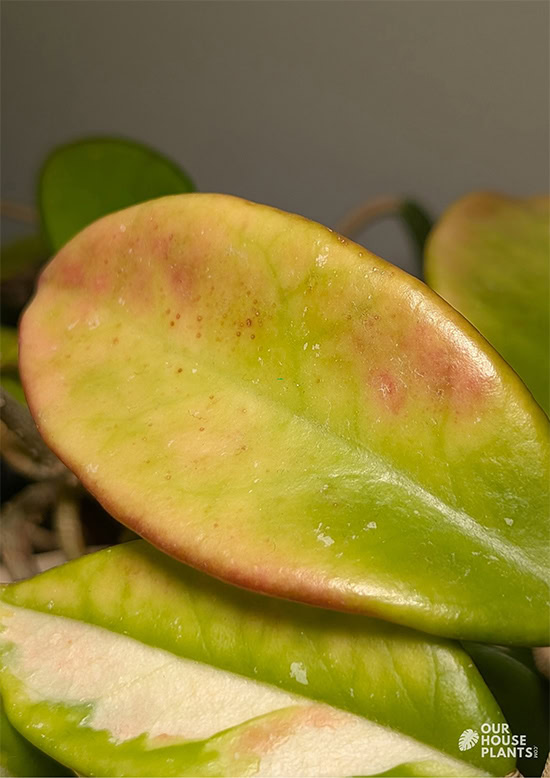
The top leaf has bleached from sun damage. You can see the red hues surrounding the edge of the leaf and the normal variegation which you can see in the leaf below has been fully washed out.
What to do
If you're seeing bleaching or scorch, move the plant back from the glass or filter the strongest sun with a sheer curtain. You don't need to send it to a dark corner. Bright indirect light, with gentler direct sun where tolerated, can support growth and flowering without baking the leaves.
Increase light gradually when changing its position, especially if it's been growing somewhere dim. The heat at the window matters as well as the light, so check how hot that spot becomes in the afternoon.
Once you've moved the plant, keep an eye out for further bleaching or scorch. Some red colouring may fade in the lower light, but damaged tissue won't turn green again. If the leaves are red but otherwise firm and undamaged, you don't necessarily have an emergency on your hands. Personally, I'd still move my plant somewhere less sunny because I prefer the greener colour.
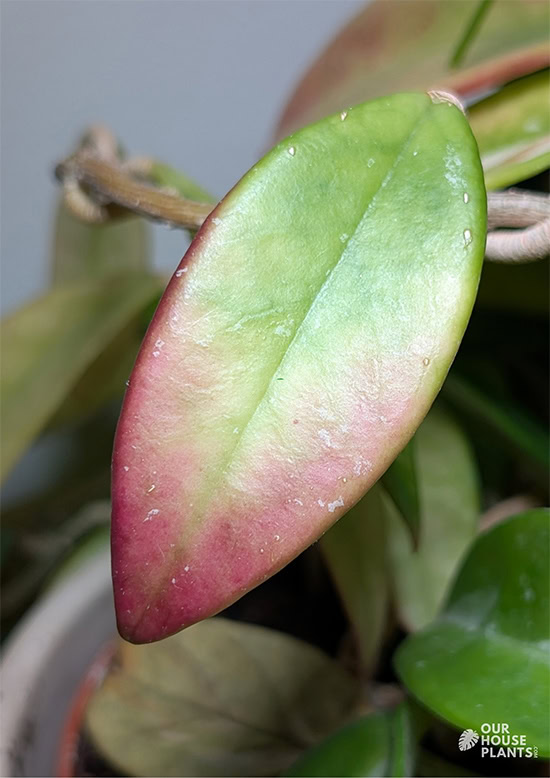
This Hoya has developed red hues around the leaf edges in strong sunlight. The colour comes from pigments called anthocyanins. Some people like the effect, but I prefer my Hoya carnosa leaves greener, so I'd give this plant a little less sun.
Leaves falling off
A single old leaf dropping isn't unusual. Several leaves falling in quick succession, or green leaves dropping while the plant declines, calls for a closer look. Notice whether they were yellow, wrinkled or damaged before they fell because that history is more useful than the fallen leaf alone.
Check these first
- Severe dryness.
If the root ball is dry and the remaining leaves are thin or wrinkled, rehydrate it thoroughly and drain. Don't be afraid to water a genuinely thirsty plant properly: the problem is prolonged drought or damaged roots, not the act of watering dry compost. - Wet compost and failing roots.
Leaf drop with wet mix, limp foliage or a soft stem base needs a root inspection, not another drink. - Cold or excessive heat.
Keep leaves away from cold glass, chilly draughts, radiators and intense window heat. If you've recently moved the plant, think whether its new position is much hotter, colder or darker than the old one. - Recent repotting.
Roots may have been disturbed, but also check whether the new pot is too big or the fresh mix stays wetter than the old one. Don't automatically water more to cure apparent repotting shock, or keep unpotting it if it's otherwise stable. - Physical damage or pests.
Check the points where leaves join the stem and inspect the remaining foliage, especially if only one vine is affected.
What improvement looks like: leaf drop slows and the remaining growth stays firm. An established bare stretch of vine won't necessarily refill exactly as before, but healthy new growth can restore the plant's overall shape.
Not growing, bare vines or new leaves not growing
Hoya carnosa doesn't always grow in a neat sequence of stem, leaf, stem, leaf. It can send out a long runner and fill in leaves later, which makes it look as though it's forgotten half the job.
Long bare vines: normal or a problem?
A firm runner with a living growing tip can be normal. Give it time before pruning.
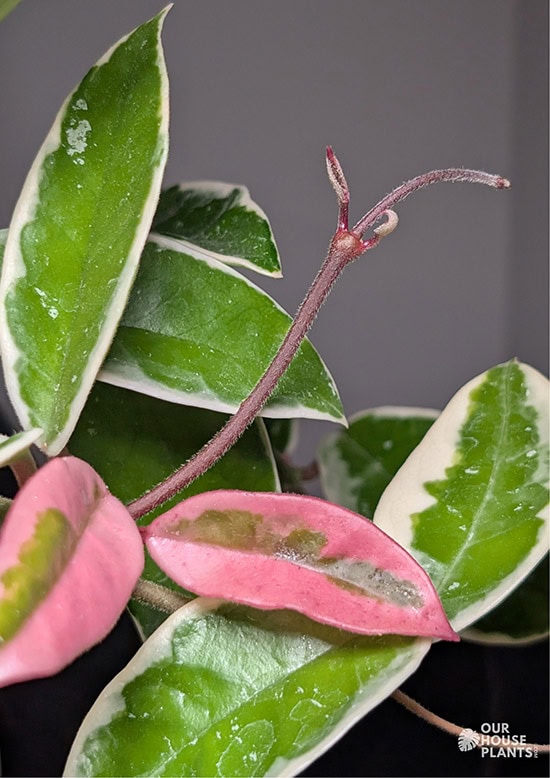
A long bare Hoya vine can look a bit odd at first, but don't be too quick to cut it off. Leaves will often appear later as the stem matures.
You're welcome to train it onto a support, but you don't have to; I prefer letting mine sprawl. However if the tip is dry and lifeless, or growth everywhere else is weak and sparse, check the conditions below rather than assuming it's just a searching vine.
If the whole plant has stopped growing
- Consider the season.
A healthy plant doing little during a dim winter usually needs patience, not extra food and water. - Review the light.
In the growing season, a Hoya in a gloomy spot may survive without doing much. Increase light gradually, avoiding the harsh conditions described in the sunburn section. - Check how the pot behaves.
A root-filled pot that dries almost immediately may need the next size up. A large pot staying wet for ages needs a different response. Don't repot simply because a few roots show through a drainage hole. - Think about the compost and feeding.
If your Hoya is healthy and actively growing, it may benefit from a little fertiliser. But if the compost has broken down and stays wet for too long, check the roots and consider repotting into a fresher, free-draining mix. Fertiliser won't fix damaged roots or make up for poor light though!
Tiny new leaves shrivel or fall off before developing
New leaves are naturally soft while expanding, so softness alone isn't a fault. Leaves that repeatedly stop, shrivel or drop are different. Check for missed waterings, damaged roots, strong heat and accidental knocks to the tender growing tip.
Inspect new growth and leaf joints closely for pests too. If growth stays distorted or fails despite suitable care, use magnification to investigate rather than assuming that no webbing means no mites. Don't start spraying for an unconfirmed pest just because a leaf has failed.
What improvement looks like: a growing tip extends and new leaves finish expanding. That can take time after root damage or a period of poor conditions; don't change the plant's care again every few days.
Not flowering or blooming
A healthy Hoya carnosa can grow plenty of leaves without flowering. It needs suitable light and enough maturity, and a young cutting may take years to reach that stage. There's no reliable shortcut that makes every plant bloom on demand.
How to improve its chances
- Give it enough light.
A spot that's adequate for survival may be too dim for flowering. Aim for bright indirect light, with gentler morning or late-afternoon sun where it doesn't scorch the foliage. Don't confuse stronger light with a need to sun-stress the plant. - Keep its old flower spurs.
Hoya carnosa can bloom repeatedly from the same short stalks. Cutting them off removes established flowering points. - Avoid unnecessary heavy pruning.
Let a young plant build up healthy growth. Constantly cutting runners back can remove potential future flowering growth as well as existing spurs. - Feed sensibly, not aggressively.
Support healthy growth with appropriate diluted fertiliser during active growth. Extra-strong feeding or a special bloom product won't compensate for poor light, immaturity or root problems. - Don't force it into a tiny pot or severe drought.
Hoyas can be comfortable in a snug pot, but deliberately starving the roots of space or letting the plant collapse isn't a dependable flowering method.
If your plant used to flower but has stopped, think about what's changed: less light, lost flower spurs, major pruning or a decline in root health. If it's a young plant that's never flowered, healthy growth is progress even before the first buds appear.
Flower buds dropping and old flower spurs
Getting as far as buds and then watching them shrivel is especially frustrating. Check for drying out, root trouble and changes in temperature or light while they're developing.
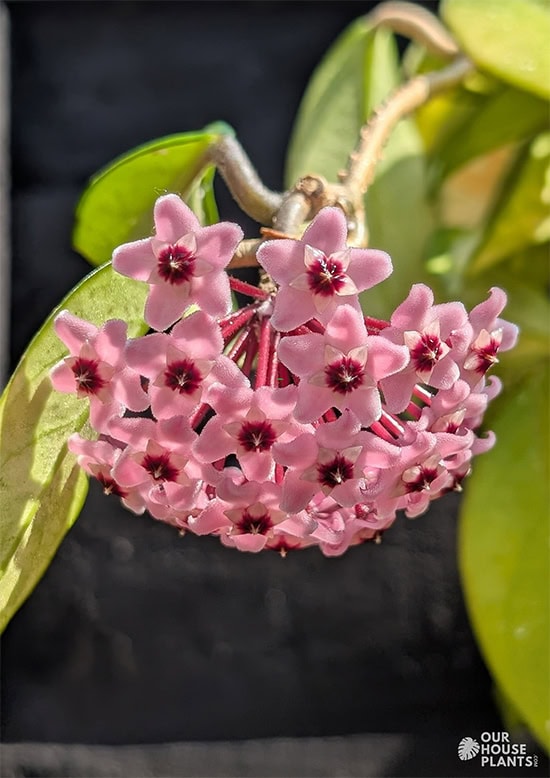
For many Hoya houseplant owners this is a welcome and frequent sight. Mine will often flower twice or three times a year. So if the buds don't come or drop off before they open this is clearly a problem.
Help developing buds reach flowering
Keep the plant in a suitable, stable position once buds appear. Avoid switching it between a bright window and a dim display spot, and keep it away from hot radiators or cold draughts. An occasional move for watering isn't the same as a major change in conditions.
Check moisture regularly so it doesn't sit bone dry for a prolonged spell, but don't keep the mix constantly wet out of fear of losing the flowers. If foliage is wilting too, investigate the roots rather than blaming the buds alone. Very hot, dry air is another reason to move it away from a heat source.
Once buds have shrivelled, they won't revive. Concentrate on getting conditions right for the next attempt instead of feeding heavily to replace them.
Should you cut off an old flower spur?
No, not just because it's woody or bare after flowering. That short stalk is a reusable flowering point, so leave it attached. If one has completely dried up and is clearly not functional, you can remove it, but there's no hurry if you're unsure.
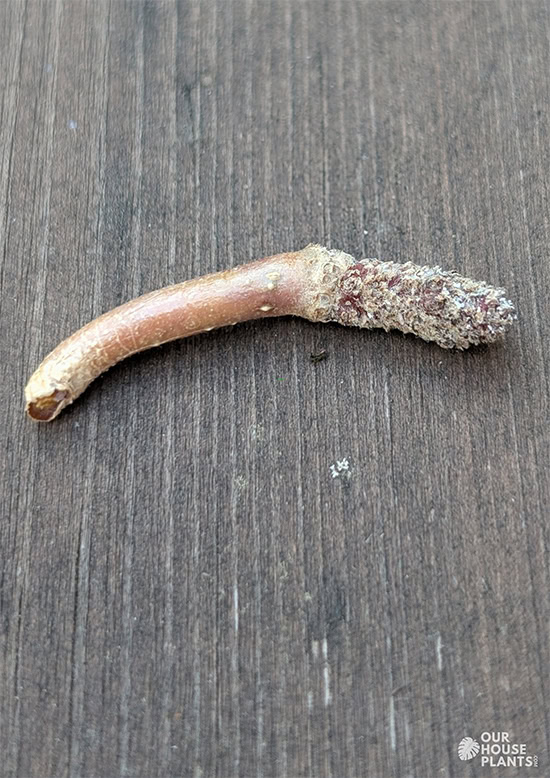
It might not look like much, but this is a Hoya peduncle (flower spur). A large number of Hoya plants will produce new blooms from an existing spur like this, which is the main reason you don't remove it from the plant.
Pests, sticky leaves and white fluff
Hoya carnosa isn't immune to pests, even when it's growing well. White cottony clusters, removable shell-like bumps, fine webbing and unexplained sticky leaves all need investigation.
Flower nectar can account for stickiness, but a flowering plant can have pests as well. Look under leaves, around the leaf joints, along vines and around flower spurs before deciding which you're dealing with.
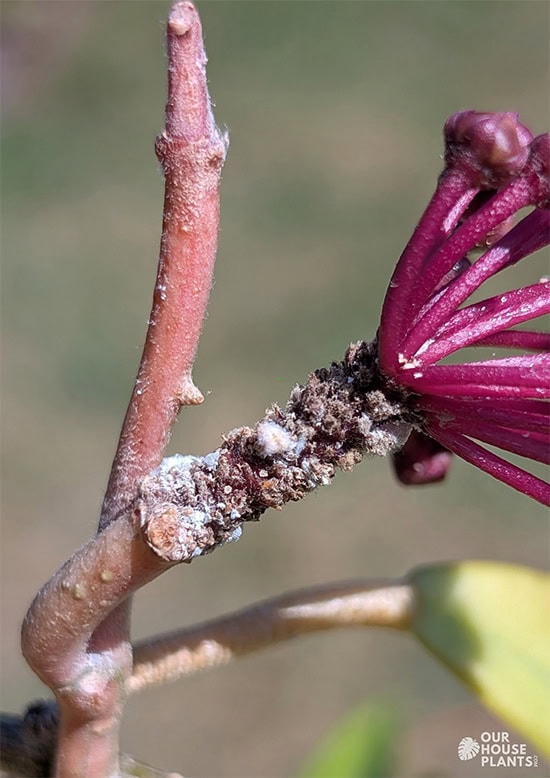
That white fluff might look like dust or dirt, but it's actually an infestation of Mealybugs. A very common pest for Hoya owners.
What to look for
- Mealybugs.
White cottony insects and deposits often hide in leaf joints and crevices. Remove small visible clusters with a damp cotton bud. Some growers spot-treat mealybugs with 70% isopropyl alcohol, but test a small hidden area first and check for damage before proceeding. Don't drench the plant or use alcohol near heat or flames. I find giving them a good rinse in the shower with warm water really does clean off a lot of them. For more tips check out my Mealybugs guide. - Scale insects.
Raised tan or brown shells may cling to stems and leaf undersides. They can often be lifted gently, unlike scars that are part of the leaf itself. Avoid damaging the tissue while removing them. - Spider mites.
Fine pale stippling, loss of leaf colour and delicate webbing are clues. Inspect leaf undersides with magnification. Carefully washing the foliage can reduce numbers, but persistent infestations need appropriate follow-up treatment. - Fungus gnats.
Little dark flies hovering around the compost aren't the same as leaf-feeding pests. If the compost is staying wet for a long time, check your watering and use yellow sticky traps to catch and monitor the adults. If needed, choose a treatment labelled for fungus-gnat larvae in indoor pots; catching the adults alone won't deal with larvae in the mix. For more tips, here's my Fungus Gnat guide. - Nectar, silver markings or dried residue.
Not everything white or sticky is an insect. Natural silver flecks sit within the leaf, while water or spray deposits sit on its surface. Flower nectar can be wiped away gently with water.
How to stop the problem returning
Separate an infested plant from the rest of your collection and inspect nearby plants. Keep checking after the visible insects are gone; hidden insects and later hatchings can restart an infestation.
If manual removal isn't enough, use a product labeled for the identified pest and suitable for indoor ornamental plants. Follow its dilution, repeat-treatment and safety instructions, and test first where recommended. Don't be tempted to increase the concentration or treat more frequently as it tends not to be effective and runs the risk of causing damage to the foliage.
What improvement looks like: repeated inspections find no fresh insects, deposits, webbing or new feeding damage. Old speckling and scars won't disappear, even after treatment succeeds.
Brown or black spots, corky bumps and scarring
A dark spot on a Hoya leaf doesn't automatically mean a fungal infection, and a raised bump isn't automatically scale. Feel and location matter: is it dry and stable, blistered and corky, or soft and spreading?
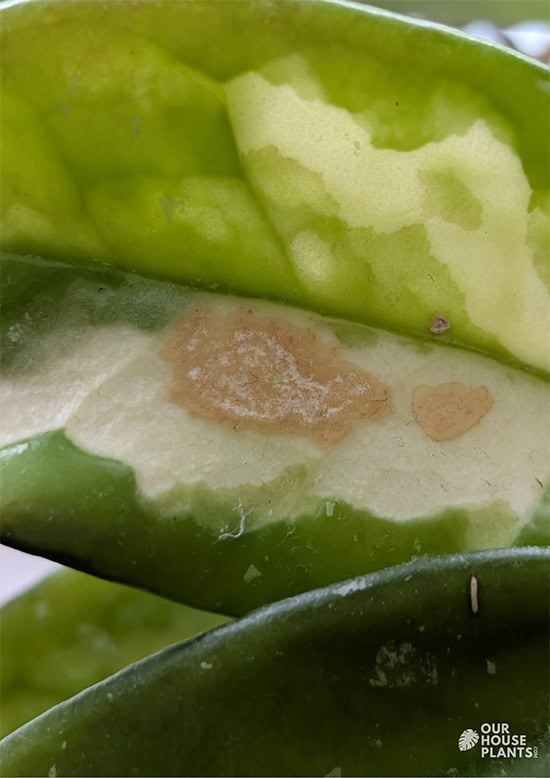
Brown marks or scars like these can have several causes, but they're often the result of physical damage.
Dry scars, scratches and creases
Physical damage can leave permanent brown or dark marks. If a spot follows an old crease, hasn't expanded and the rest of the leaf is firm, it may simply be a scar. Leave a useful green leaf in place and keep an eye on it rather than treating it for disease.
Small blisters or corky bumps: possible oedema
Oedema, also spelt edema, happens when water uptake exceeds what the leaf can release. Damaged cells can leave blister-like patches that later become rough or corky, sometimes most noticeable underneath the leaves.
Check whether the mix stays wet in cool, dim conditions. Let it dry down appropriately, improve light if needed and allow gentle air circulation. Don't put the plant in a cold draught or add more water to cure the bumps. Oedema isn't a contagious pest or disease, and existing corky scars won't heal.
Raised bumps that lift away
These could be scale insects. Check with magnification and gently test an individual bump rather than scraping at every mark. A corky scar is part of the leaf; removing it damages the tissue. See pests and sticky leaves if you confirm insects.
Soft, wet-looking or expanding spots
Soft, wet-looking spots are worth investigating, particularly if they're getting bigger, new ones are appearing or the stems are softening too. Separate the plant from your others while you check its roots and think about whether it's recently been exposed to cold or strong sun. It's also a good idea to avoid wetting the leaves unnecessarily while you work out what's going on.
Take a photo of the affected leaves so you can compare them over the next few days. If the spots keep spreading, you can remove badly affected leaves with clean scissors. If the whole plant is collapsing or the stem base is mushy, follow the root and stem rot rescue steps instead.
What improvement looks like: existing marks stop expanding and new growth develops without fresh damage. A Hoya doesn't need spotless older leaves to be healthy, so don't strip it of useful foliage while waiting for cosmetic perfection.
About the Author
Over the last 20 years, Tom has successfully owned hundreds of houseplants and is always happy to share knowledge and lend his horticulture skills to those in need. He is the leading content writer for the OurHouseplants Team.