
Monkey Tail Cactus: Care Guide
The Monkey Tail Cactus Houseplant
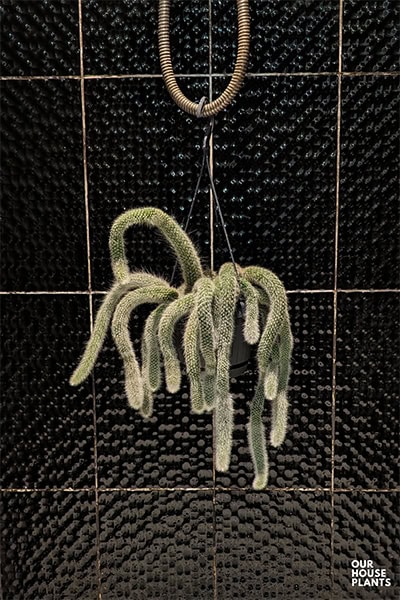
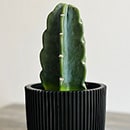
The Monkey Tail Cactus, also known as Cleistocactus colademononis, is a fairly easy care succulent with a fuzzy appearance that delights most people who come across it. Its long, cascading stems are covered in soft, white spines, giving it the whimsical appearance of a Monkey's Tail.
It's a fantastic houseplant that's surprisingly easy to grow once you get its basic care right. It has a distinctive trailing habit and looks incredible in hanging baskets, allowing its soft, fuzzy stems to cascade.
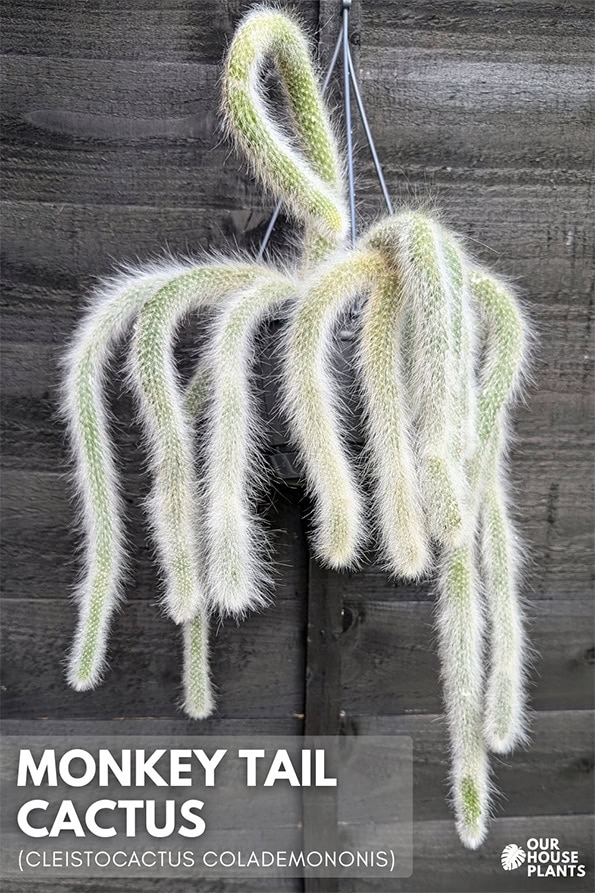
The plant's resemblance to a Monkey's Tail is obvious, even from a quick first glance.
Native to the mountains of Bolivia, the Monkey Tail Cactus is an epiphytic plant, meaning it grows on other plants or rocks in its natural habitat, rather than directly in the ground. This is why it looks so good in a hanging basket.
How do you pronounce Cleistocactus colademononis correctly? Say:
Kly-stoh-KAK-tus koh-lah-deh-moh-NOH-nis.
I've been a fan of this cactus ever since it became more widely available. Unlike many cacti with sharp, painful spines, the Monkey Tail Cactus is perfectly safe to touch (or stroke).
Did You Know?
The Monkey Tail Cactus is a relatively new introduction to the houseplant world. It was first cultivated in the 1960's to little interest. It was then officially described in 2003, but it was only in the last five years or so that it started to be sold on a larger scale, making it a very modern addition to our indoor plant collections.
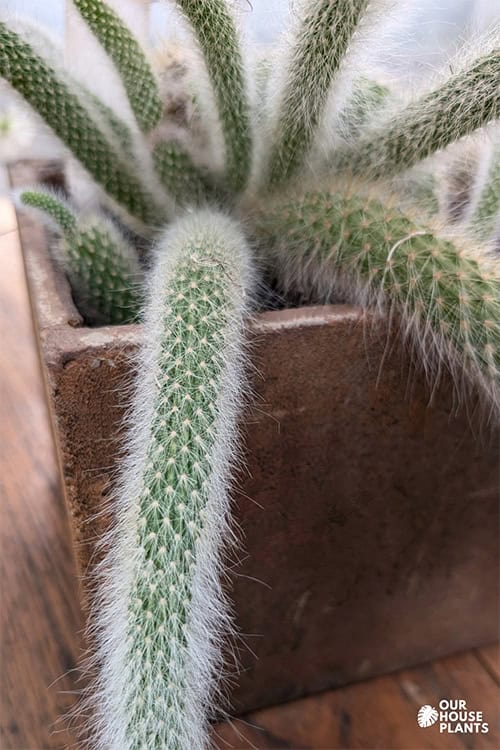
The "fuzzy" white spines are actually very fine, hair-like spines that protect against intense sunlight. In its natural habitat, these hairs act like a natural sunscreen, reflecting harsh light and preventing the stem from getting scorched. This makes it one of the most gentle cacti you'll find.
If you make a beeline for one of these plants, do take care because there is a very closely related subspecies that is often sold in stores, sometimes incorrectly labeled as the Monkey Tail Cactus. This is actually Cleistocactus winteri AKA the "Golden Rat Tail" and its spines are a little more like a familiar cactus, they don't hurt as such, but the spines are easily transferred into your skin and can be highly irritating.
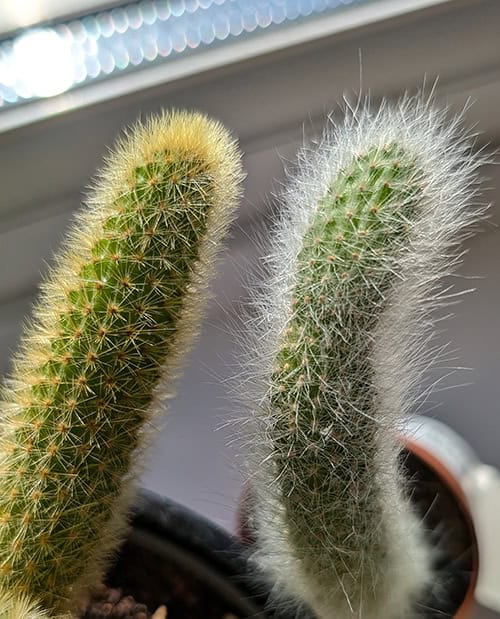
(Left) Cleistocactus winteri - "Golden Rat Tail" and (right) Cleistocactus winteri subs. colademononis - "Monkey Tail Cactus".
On closer inspection, the difference between the two is fairly obvious. The Golden Rat Tail has shorter, more ridged spines with a hint of yellow, and the stems are a green-yellow or almost lime color. In contrast, the Monkey Tail Cactus has longer, hair-like spines that are always white, and the stems are pure green with no yellow.
While the stems on the Monkey Tail can grow to an impressive length, they are quite brittle and can break easily, so be careful when handling or moving the plant. These broken stems can, however, be used for propagation.
A Name You Can’t Forget
The scientific name "colademononis" translates to "tail of a demon." This is a nod to its long, cascading stems and the white spines that give it a somewhat wild "swish swish" appearance.
The main thing you'll need to remember for a healthy Monkey Tail Cactus is to give it lots of light and avoid overwatering. These are the most common mistakes made by new owners.
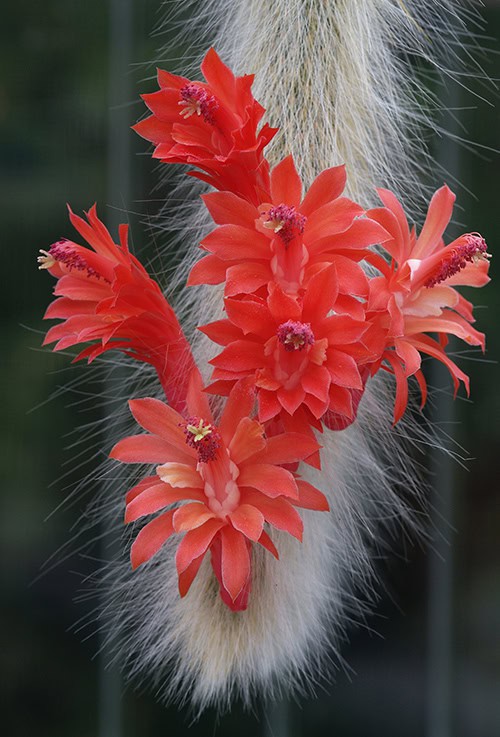
If you can deliver on these basic needs then with proper care, it will produce stunning red-orange flowers that add to its unique charm.
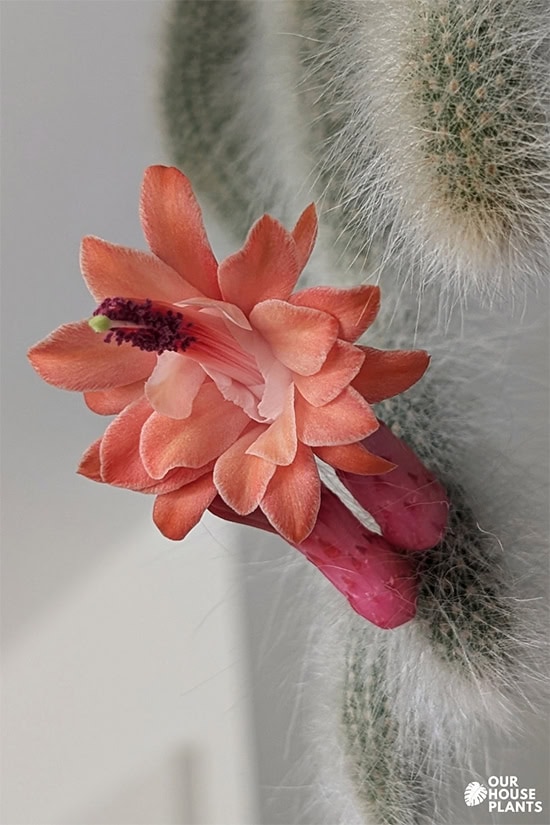
The soft spines and vibrant red-orange flowers are what make the Monkey cactus a true show stopper.
I assume if you're reading this you already own this plant and are looking for some plant care tips. So read on and I'll share what I've learned growing mine over the last few years.

Hi, I'm Tom!
If you're like me and enjoy the challenge of growing houseplants and getting them to thrive, then OurHouseplants can help. This website shares my knowledge and years of growing plants and provides my advice on properly caring for your indoor plant friends.
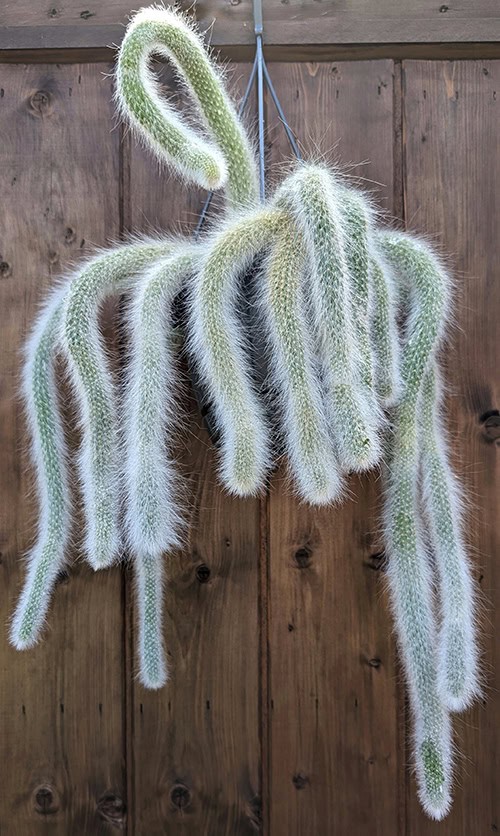
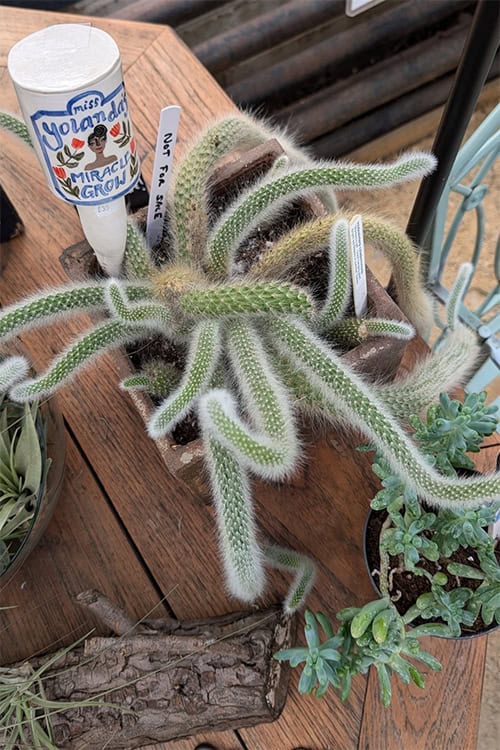
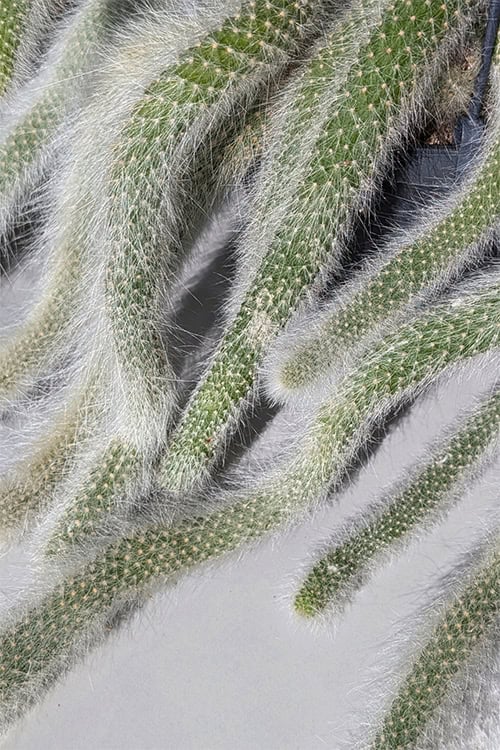
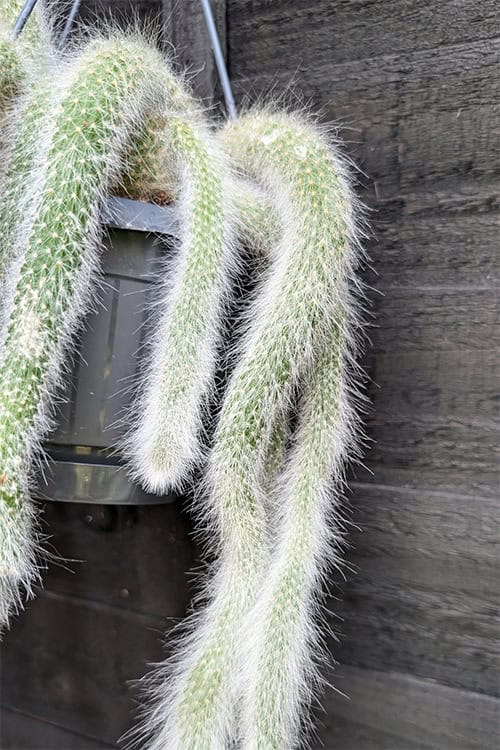
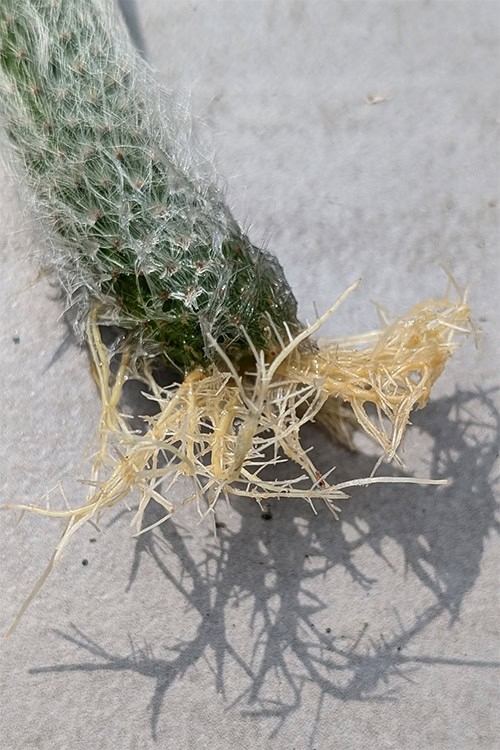
Monkey Tail Cactus Photos
Care and Growing Guide
Light
The Monkey Tail Cactus does best in bright, direct sunlight for at least a few hours a day. Think of its native mountain habitat, where it's exposed to intense sun. A south-facing window (in the Northern Hemisphere) or a very bright, unshaded spot is ideal.
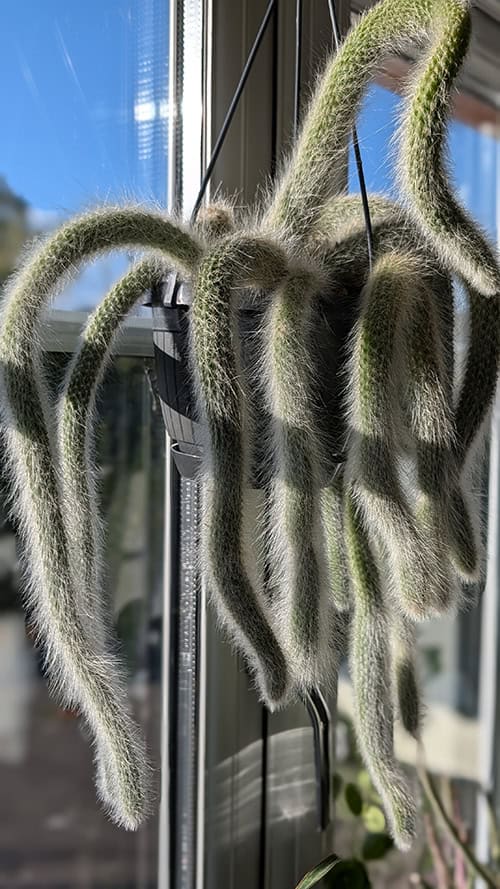
They can be grown in normal planters and containers, but I think they look their best in a hanging pot or basket like this. Here is mine, basking in a sunny South-West facing window.
While it loves bright light, be cautious of extremely intense, full sun, especially if moving it from a shadier spot. Too much sudden, harsh sun can cause the stems to yellow or burn. Gradually introduce it to brighter light if it's been in lower light conditions.
Light Levels and Growth
In lower light conditions, your Monkey Tail Cactus will grow very slowly and may produce thinner, weaker stems. For robust growth and to encourage flowering, strong light is essential.
If the light levels are too low for a prolonged period, new growth will be thin, leggy, and elongated. This can serve as a guide to assess your plant's happiness. If it's looking pale or thin, it likely needs more light. If it's getting brown burn spots, it might be too much sun.
Watering
Watering is likely the biggest challenge for new owners. Getting the frequency and amount of water wrong accounts for 90% of the problems people ask me about.
As a cactus, it's highly drought-tolerant and very susceptible to overwatering. If you're prone to making mistakes with watering then the "soak and dry" method is the best way to grow these plants. Water thoroughly, so the potting mix is saturated and water is draining from the pot's base, then allow the soil to dry out completely before watering again.
Wait until the potting mix has completely dried out. You could even wait for a few days after this happens before watering again. This ensures the roots get a good amount of air and helps prevent rot.
Like this plant here, the stems should look and feel firm and plump when the plant is well-hydrated. Shriveling stems or a washed-out appearance are signs it needs a drink.
The frequency of watering will depend on your growing environment (which is true for almost every houseplant). It will take far longer for the potting mix to dry out over Winter when temperatures are cooler and there is less light.
In the dormant months of Autumn and Winter, reduce the amount of water you give as well as the frequency significantly, only once a month, or when the stems start to look slightly shriveled and pale. In a smallish container, with high temperatures and plenty of direct sun, you could be watering once a week.
Humidity
Humidity is not a concern for the Monkey Tail Cactus. These plants are adapted to dry, arid environments and do not require any extra humidity. In fact, high humidity combined with overwatering can quickly lead to rot.
My home humidity is variable throughout the year, but my Monkey Tail Cactus has never had any issues with it. They are very tolerant of low humidity levels.
Since they are epiphytes, they need to breathe. Stagnant, humid air can be detrimental to their health, so a well-ventilated spot is always best for them. Focus on good air circulation rather than humidity changes.
Feeding
The Monkey Tail Cactus is not a heavy feeder. It still needs nutrients, but it's not up there with the seriously hungry plants. These plants also produce some very nice looking blooms that need to be fueled.
A balanced, water-soluble fertilizer with a formulation such as 10-10-10 is the way to go. These numbers mean the fertilizer contains equal parts nitrogen (N), phosphorus (P), and potassium (K), providing all the essential nutrients for plant growth.
Winter Feeding
Unless you can see your plant is still growing, do not fertilize during the Autumn and Winter dormancy period. For everyone else, stop doing it towards the end of Summer and resume the following Spring.
You don't have to look for this perfectly balanced mixture, but if you're presented with several and this is an option on the shelf go for it. Any feed that mixes all three NPK nutrients will aid your plant's growth and health.
Dilute it to half or even quarter strength and you can feed your plant once a month during the growing season. Too much fertilizer can cause leaf burn and damage the roots.
Temperature
Average or warm temperatures are what this plant is looking for during the growing season, ideally between 21°C (70°F) - 29°C (85°F). They're not fans of cold temperatures so try not to let it dip below 10°C (50°F) at any point. A cooler winter rest period is often beneficial for cacti as it can encourage stronger growth and more flowering the following year, but it's not an essential requirement.
Repotting
The great news here is that the Monkey Tail Cactus doesn't need frequent repotting. They're actually epiphytic plants, so the root system is comparatively smaller than other houseplants.
Some plants will stop growing if the planter is too small though. The roots do need some space. They'll also benefit from a fresh potting mix every few years. The old stuff will eventually break down and struggle to hold nutrients and water.
Aim to repot once every two or three years. They won't need giant sized containers. Just a little bigger than the previous one will be ideal.
You can also watch my Care Guide over on YouTube.
What kind of potting soil should I use?
Your Monkey Tail Cactus will struggle in dense potting mixes that stay wet for long periods. They need fast draining soil. For that reason, peat moss compost should be avoided.
Did You Know?
The Monkey Tail Cactus is found in the Santa Cruz region of Bolivia, where it grows as an epiphyte on cliff faces and rocky outcrops at altitudes of over 1,500 meters (5,000 feet). This is why they thrive in well-draining soil and with plenty of light in our homes.
A well-draining cactus and succulent potting mix is the way to go. You can also amend a regular potting mix with larger materials like perlite, pumice, or coarse sand to improve drainage if needed. All things cacti love.
Propagation
Propagating the Monkey Tail Cactus is straightforward. I've done it before and it's a great way to share your plant with friends. You can also replant the cuttings in with the parent plants to create a "bushier" looking plant.
To get started, select a healthy stem of a few inches or so and cut or snap it off. This may also happen by accident whilst you're watering or moving your plant around.
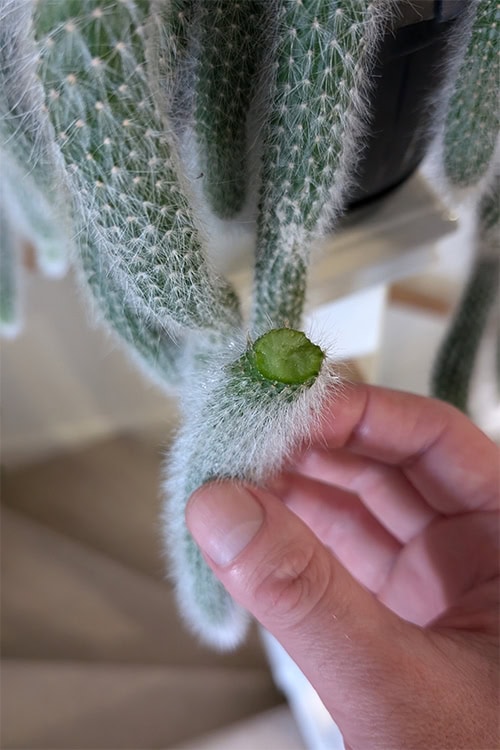
This is what you need to propagate a new plant. It may be deliberately removed using clean, sharp scissors or pruners, or, as happened to me, it accidentally snapped off when I carelessly moved it between rooms.
Top Tip
After cutting, allow the cut end to callus over for a day or two. This forms a protective seal and greatly reduces the risk of rot once it's planted.
Once callused, you have two options. You can either propagate directly into a potting mix or by using water.
If opting for the soil option, insert the cut end about 1-2 inches deep into a well-draining cactus potting mix. Water lightly which will help settle the cutting into the potting mix and stimulate the root growing process.
Place it in a very bright location, it will even take some direct sun. Keep the soil barely moist, allowing it to dry out completely between waterings. Roots should form within a few weeks, and new growth will eventually start growing at the tip.
Once the cuttings have rooted and established themselves, you can treat them like mature plants and continue to care for them accordingly. Remember to be patient, as they can take some time to develop roots and new growth.
If you decide to opt for water propagation you need a jar or vase of tap water and you then need to insert the cutting so the first cm or so is submerged. Do not submerge any more than this to reduce the chances of rot.
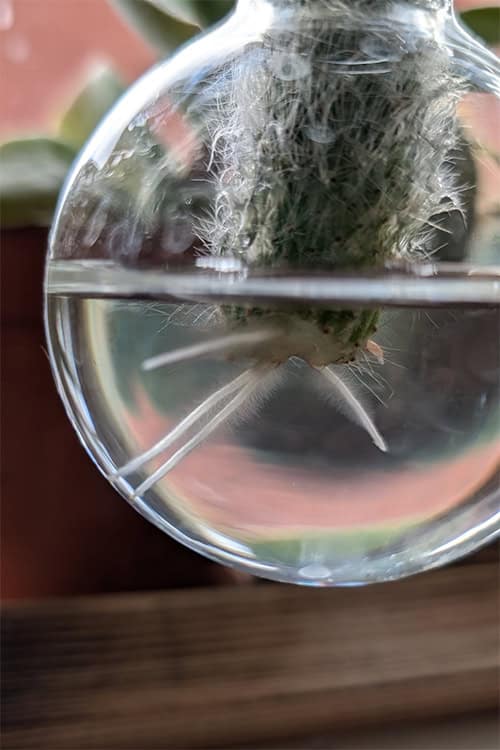
Perhaps surprisingly water propagation for these plants has a very high chance of working as long as you do it during the Spring or Summer months. After a few weeks, here you can see roots have started to grow.
Again, place the vase and cutting in a warm bright location. This combination stimulates roots to form and grow at the cut location as you can see in the photo above.
It will take several more months to grow a comprehensive root system. When the cutting starts to look like what you can see in the photo below, it's time to move it on to a potting mix.
This progress can be expected within 2 months of taking the cutting. It takes a while to get going, but now there is a good root system this will help support the plant when it's moved into a potting mix.
Once potted up, keep it in a bright warm location and ensure the potting mix stays damp rather than fully saturated. You can start to water it like you do the parent plant a month or two after establishing.
Speed of Growth
The speed of growth for the Monkey Tail Cactus is generally moderate with seasonal periods of growth. Given optimal conditions, they can produce several inches of new growth per year over the Summer months, with established plants developing impressive long tails.
How big can it get?
In optimal conditions, individual stems can grow quite long, typically reaching 60-90cm / 2-3 feet in length when mature, and sometimes even longer in ideal conditions. As they grow, they will spread by cascading over the sides of the pot.
Flowers
The Monkey Tail Cactus produces striking bright red to orange, tubular flowers. These blooms typically emerge from the fuzzy stems in late Spring through to late Summer and will usually last for several days before wilting and falling off.
With good care and maturity it's not uncommon for a stem to produce multiple flowers at once or over the space of a month or two - photo by Dornenwolf
Typically a single flower will appear (although larger and very mature plants can produce more) at the side of a stem. It looks very intricate and beautiful.
Top Tip
A cool, dry winter rest period is often beneficial for encouraging blooms in the spring and summer. Make sure your plant gets plenty of light!
Plants don't always flower. Here are a few conditions that generally have to be met (or will encourage) flowering.
- Maturity. Only older and established plants will produce flowers. This could be three years or more.
- Bright Light. Strong light is thought to be a trigger for encouraging blooms to form. If you've had your plants for years and nothing has appeared you might want to think about putting it somewhere with more light.
- Cool, Dry Winter. A cool winter rest period (around 10-15°C) with significantly reduced watering can be important for flower bud formation.
Is the Monkey Tail Cactus safe around pets?
The Monkey Tail Cactus is not considered toxic to pets or people. Its soft, hair-like spines also make it one of the safer cacti to handle.
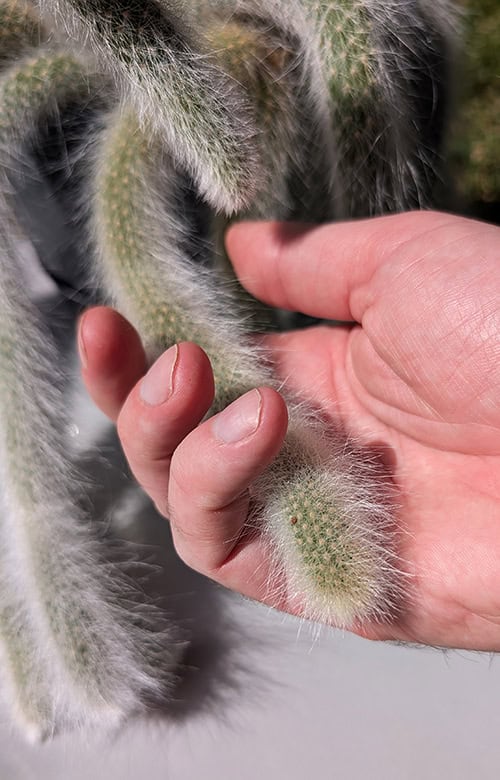
The long soft hairs are designed to protect the plant from intense sun and water loss through transpiration. They don't confer protection from predators so are safe for us to handle
Anything Else?
The Monkey Tail Cactus doesn't need much maintenance to look good, but the hairs can attract dirt and dust. A quick wash in a shower (either in your bathroom or outside during a rain shower) will help rinse away the dust and keep the hairs clean and debris free.
I will give my plant a shower once a month, not necessarily because it's dirty, but it makes it very easy to water it like this! I'll leave it for an hour after watering to let it dry off a little before moving it back to its usual spot.
How to Grow Recap
- Bright, Direct Light
Prefers several hours of direct sun daily. Will take a broad range of light conditions but may not grow or flower well in lower light. - Low Watering.
A good soak followed by a period of drying out is needed. Only water again once the potting mix has completely dried out. They are extremely sensitive to overwatering. - Warmer Temperatures Preferred.
Aim for above 21°C (70°F) during the growing season. A cooler winter rest period around 10°C (50°F) can encourage blooms. - Occasional Feeding.
A normal cactus feed once a month is usually plenty. You can dilute the concentration and feed more regularly if preferred. Stop feeding over Winter. - Overwatering is the most common problem.
These plants will deal with most things, but overwatering can finish them off quickly. Make sure the planter it's in has at least one drainage hole, the potting mix is free draining and give them time to dry out before watering again. - Avoid cold temperatures.
They're tropical plants and don't like cold temperatures. They're not hardy, so the lowest they can go is just above Freezing,
Common Problems and Issues
Dusty and dirty stems.
The Monkey Tail Cactus has long, fuzzy stems that can easily collect dust over time.
A quick rinse in a shower should help clean things up. You can also use a soft paintbrush to gently remove dust from the spines.
Broken Stems.
The stems have some flexibility to them, but they will snap off with rough handling. You can use these broken stems for propagation. The cut end will callus over and the plant should sprout new replacement growth which you can see happening below.
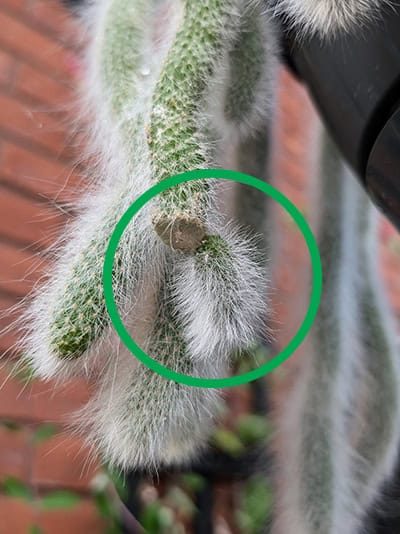
The plant will grow around damaged areas and produce replacement growth.
Stems are soft and mushy / plant rotting.
This is almost always a sign of overwatering. Too much water and not letting the potting mix dry out will cause root rot and stem rot. Attempting to grow your plant in wet soil for prolonged periods, must be avoided otherwise the stems will become soft and mushy at the base.
So what does it mean if you have a soft, mushy plant? Let's do some troubleshooting.
- Overwatering. This is the most likely reason. Too much water and not letting the potting mix dry out will cause root rot and with that comes mushy stems.
- Too little sun. A lack of light combined with a moist potting mix can make the plant more susceptible to rot.
- Fungal Disease. Less common, but a fungal infection can also cause rot. This is often a result of high humidity and poor air circulation.
Established stems are shriveling / thin.
If established stems look shriveled or deflated, it's usually a sign of underwatering. While they are drought-tolerant, they still need water.
Give the plant a good, thorough soak (allowing water to drain) and the stems should plump back up. This is much easier to fix than overwatering.
New stems are thin / Etiolation.
When new growth is looking a lot thinner in comparison to the existing stems, it's called Etiolation.
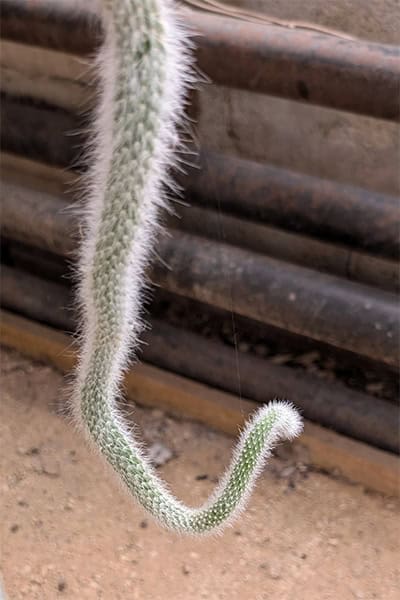
Etiolation is permanent - You cannot make a cactus grow thicker where it is already etiolated. You need to prevent it from happening to start with.
The primary reason for this is insufficient light levels. Remember the Monkey Tail Cactus needs a position in your home that gets full sunlight. The wrong facing window or even being situated too far away from the window itself, can both trigger Etiolation.
"Can I fix a thin stem?"
Unfortunately no, true etiolation can't be fixed. The thin part won't thicken up. But you can cut it off and start again!
Once it's happened, you can't make the new growth grow thicker. However, you can "go back" to the healthy, thicker growth by cutting off the new, thinner stems. If you're not bothered by the look, then leave it, but if you dislike the appearance, unfortunately, you need to be aggressive in your approach.
No Growth.
They tend not to grow all year round so some dormant periods are normal. But there can be other causes for lack of growth.
- The Pot is too small. They're not adverse to smaller planters, but very small ones will eventually restrict growth. Repot the plant into a larger container to provide room for root expansion.
- Low Light. They will cope with lower light levels, but will grow very slow or not at all.
- Lack of Feeding. These are less likely to happen, but a complete lack of nutrients can stunt growth.
- Winter Dormancy. This is a very normal period for the plant to stop growing, especially with cooler temperatures and less light.
Brown Areas / Corking
Any damage to your plant, whether intentional, i.e. taking propagation material, "pruning" or accidental, will result in the damage forming a "scar". This is a brown callus that serves to protect the plant from infection and attack from pests. It's very common on cacti and succulents and is officially called "Corking".
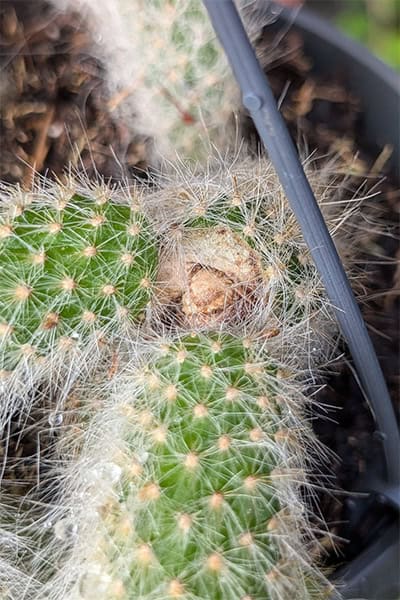
Corking is a natural part of growing cacti, but it can be unsightly. To prevent damage and corking, take care of your plant.
No Flowers.
Check out my flower section in the care guide above for some pointers to help get your Monkey Tail Cactus flowering.
Pests.
Pests are not a common problem for this plant, but it's not immune.
Mealybugs and scale insects could all be found in among the stems. Treat infestations with insecticidal soap or by dabbing the spots with a cotton swab dipped in rubbing alcohol. Inspect regularly.
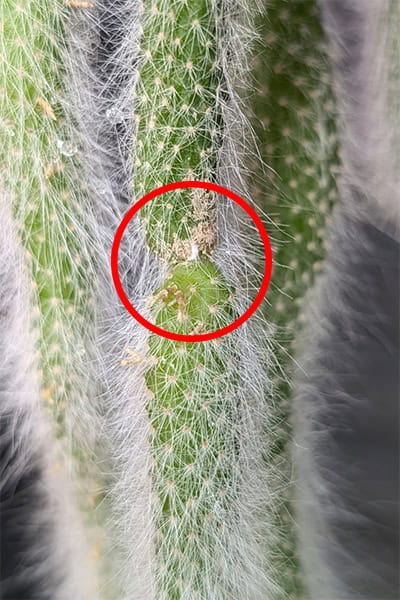
The Monkey Tail Plant is normally pest free but bugs like the Mealy Bug can get in and set up home among the soft white spines.
Faded Washed Out Stems.
Multiple things can cause this to happen.
- Underwatering. A few days after the potting mix has fully dried out the stems may start to look washed out and faded.
- Too much light. Extreme sun can bleach the stems. It's an early sign of a sunburn that can lead to browning.
Yellow or Brown Stems.
This could be due to a few reasons. Too much sudden, intense direct sunlight can cause yellowing or browning (sunburn). Gradually acclimate your Monkey Tail Cactus to brighter light.
On the other hand, if the plant is in very low light, it might also show signs of stress, including a lack of vibrant green color and new growth being a lot thinner. Ensure it's getting adequate bright light for a healthy appearance. Overwatering can also lead to yellowing stems. The solution is usually simple, either move it to a brighter spot or reduce watering.
About the Author
Over the last 20 years, Tom has successfully owned hundreds of houseplants and is always happy to share knowledge and lend his horticulture skills to those in need. He is the leading content writer for the OurHouseplants Team.
Also on Ourhouseplants.com


(Gallery / Article) Monkey Tail Cactus with six flowers blooming - Dornenwolf