Venus Flytrap Problems and Common Issues Guide
Your Venus Flytrap Problems Solved
Venus Flytraps have a reputation for being one of those plants that's either doing brilliantly or is ready for the bin, with not a lot in between. There's some truth to that, but in my experience most of the plants that get written off were fixable, the owner just didn't know what they were looking at.
A lot of what looks alarming on this plant is actually normal. Traps go black, the whole thing shrinks back in winter, and it sulks for a few weeks after coming home from the shop. Then there are the genuine problems, nearly all of which come back to the same handful of care mistakes.
This guide will help you work out which is which, and what to do about it.
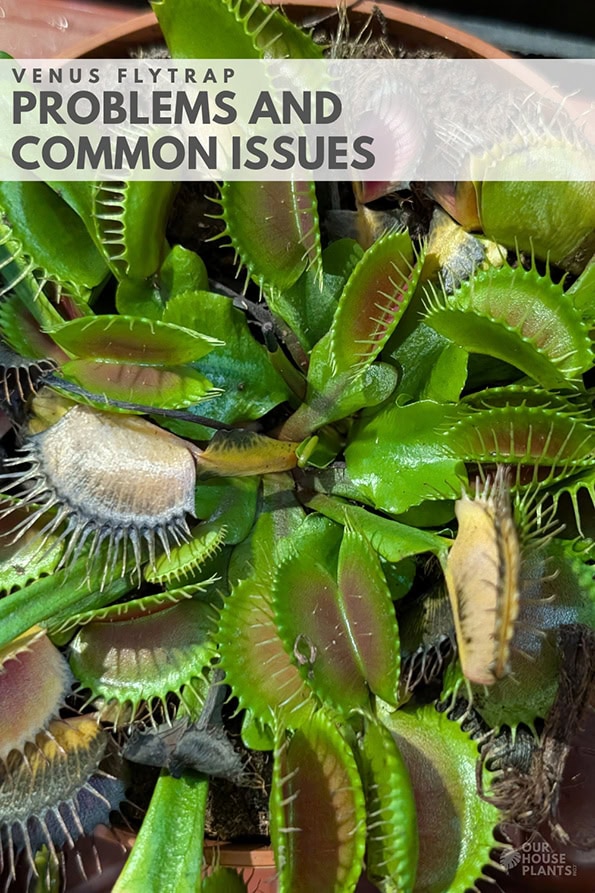
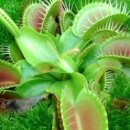
If your Venus Flytrap looks like this, it might be perfectly fine... or it might need some help. The sections below will help you work out which.
Before you go any further, it's worth a quick look at my Venus Flytrap care guide. Almost every problem below is caused by one of the golden rules being missed, so if you're not sure what they are, that's the place to start.
If you already know the basics and your plant is still struggling, let's find out why.
Before you panic: is it actually a problem?
Venus Flytraps can look dramatic even when they're perfectly healthy. Before assuming the worst, use this quick check.
- One or two traps going black, with new growth in the middle?
Usually normal. Older traps do not last forever and are replaced as the plant grows. - The whole plant shrinking back between Autumn and early Spring?
It may be going dormant. This can look alarming, but it is an essential part of the plant's yearly cycle. - Several traps going black at once in Spring or Summer, with no healthy new growth?
That is more likely to be a real problem. Check the light, water quality and whether the growing medium has ever dried out. - The centre of the plant is soft, brown or smells unpleasant?
That points to rot rather than normal ageing or dormancy. Take action straight away.
What's wrong with my Venus Flytrap?
- Traps turning black
- Traps turning yellow
- The whole plant is going black and brown
- Traps won't close, or close slowly
- A trap has closed and won't reopen
- Long floppy leaves and tiny traps
- Traps aren't red
- Crispy brown leaf edges
- Grey fuzzy mould
- White crust on the soil or pot
- Pests
- Declining a few weeks after you bought it
Traps turning black
This is the number one worry, and the honest answer is that most of the time it's completely normal. Remember that each trap is a modified leaf with a limited life. It opens, catches a few meals (or doesn't), and after a few weeks or months it blackens from the edges inwards and rots away. A new one should grow from the centre of the plant to replace it.
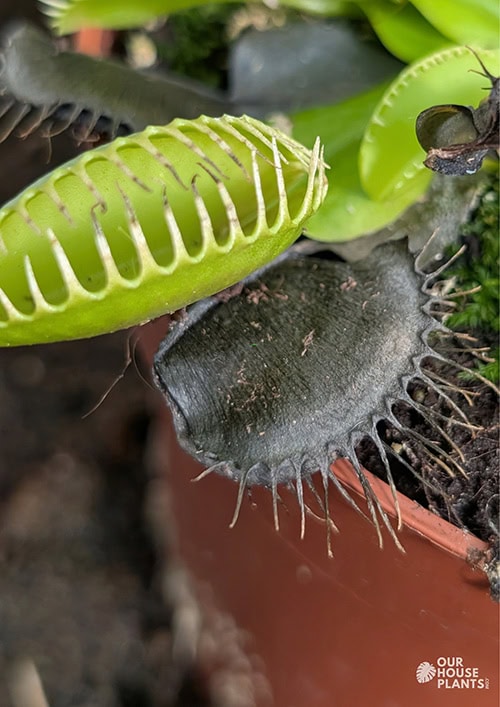
A fully black Venus Flytrap trap has reached the end of its useful life. One or two of these is perfectly normal, especially when fresh growth is coming through from the centre.
A healthy plant will have a black trap or two on the go at almost any time of year. One or two blackening while new growth keeps coming through the middle is fine. Lots going at once, or black traps and no new growth, means something's up.
Causes
- Old age.
The most common cause by miles and there is nothing to fix here. Snip the finished trap off at the base once it's fully black and dry if you want the plant to look tidier, or leave it, it doesn't matter to the plant. - It's caught something too big.
If a trap closes on a meal more than about a third of its size, it often can't seal properly, the contents rot before they're digested and the trap goes black. It's one trap lost, not the plant. Don't feed traps anything oversized and avoid poking things into them for fun. - Winter dormancy.
From Autumn onwards it's normal for most of the traps to blacken and look pretty awful as the plant rests. See the next section for how to tell winter dormancy from something else. - Tap water or fertiliser.
If traps are blackening fast in the growing season and new growth is stunted or also going bown, have a look at the water and the soil. Minerals from tap water or nutrients from ordinary compost burn the roots and the damage shows in the leaves. Switch to rainwater if you can and if it's been potted in normal compost, repot into a proper carnivorous mix. - Too little light.
A plant in a dim spot can't make enough energy to support its traps and lets them go. If the new growth is also weak and floppy, that's your answer.
Yellow traps or leaves
A Venus Flytrap leaf can turn yellow before it goes brown or black, and one or two doing this is not normally a disaster. It is often just an older trap reaching the end of its life, especially if fresh green growth is still appearing from the middle of the plant.
What matters is whether it is isolated to an older leaf or happening repeatedly across the whole plant. Yellowing new growth, several leaves changing colour at once, or yellow leaves combined with weak growth usually means the plant is under stress.
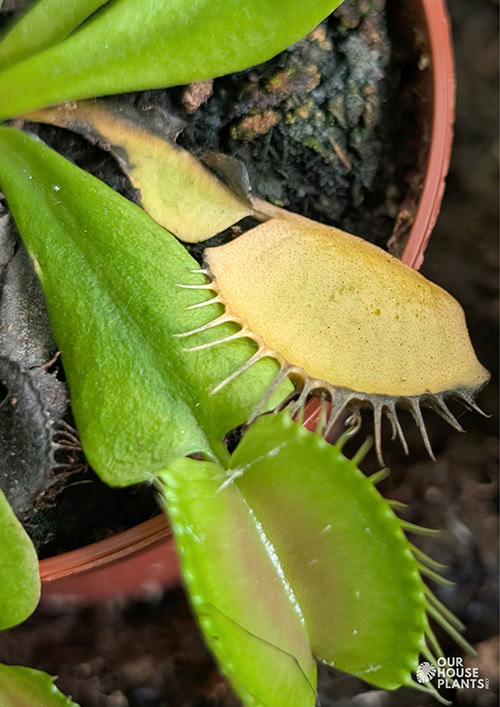
An older leaf turning yellow is usually just on its way out. If most of the plant is doing it, check the causes below.
Causes
- Normal ageing.
Older traps do not last forever. They can fade from green to yellow before turning brown or black and dying back completely. If new leaves are growing from the centre, there is nothing to fix. Leave it until it is fully dead and dry, then trim it off if you want to tidy the plant up. - It is settling in after purchase.
A newly bought plant often loses a few of the traps it had in the shop while it adjusts to different light, water and temperatures at home. Yellowing leaves can be part of that process. Give it strong light, the right water and a few weeks to start producing growth suited to its new home. - Not enough light.
In poor light, Venus Flytraps cannot make enough energy to maintain all their leaves. They may become paler or yellowish before declining. If the plant is also producing long, floppy leaves and small traps, see long floppy leaves and tiny traps. - Wrong water or unsuitable compost.
Mineral build-up around the roots can cause leaves to fade, yellow and eventually blacken. This is most likely if tap water has been used regularly, or if the plant is growing in ordinary houseplant compost. Switch to rainwater, distilled water or deionised water and repot into a proper unfertilised carnivorous plant mix if needed. - Seasonal die-back.
As Autumn arrives and the plant heads towards winter dormancy, older leaves may yellow and die back along with the traps. This is normal if the timing is right. See the whole plant is dying back if you are not sure whether yours is resting or genuinely struggling.
The whole plant is going black or brown
If it's between roughly October and February, it may well be fine. Venus Flytraps go dormant over winter and it looks awful. Traps blacken, leaves shrivel, and what's left can be a sad little rosette of tiny leaves sitting close to the soil. Plenty of owners will bin a perfectly healthy plant at this stage.
The question you need the answer to here, is whether the rhizome (the white bulb-like bit just under the soil) is still alive. That's the plant. The leaves are just what it's wearing this season.
How to check
You only really need to investigate further if the plant is collapsing at the wrong time of year, smells rotten or the growing medium has been allowed to dry out completely. In that case, gently tip it out of its pot and brush a little growing medium away from the base. A living rhizome is white or pale pink and firm. If it's brown, soft or mushy right through, then it's gone. If any part of it is still firm and white, pot it back up into fresh medium to give it the best chance you can.
Causes
- Normal winter dormancy.
Nothing to fix. Keep it cool, and the growing medium just damp and wait for Spring. Full instructions in the care guide. - Dormancy was skipped.
A plant kept warm and growing all year can gradually weaken, even if it looks okay for a while. It may start producing smaller traps, lose leaves more quickly or decline without an obvious single cause. If yours is still alive and has never had a proper winter rest, make sure it gets one this year. - Rot.
Sitting in water is fine in Summer, but combine wet compost with cold and dark in winter and the rhizome can rot. If it's soft and smells off, that's likely what's happened. Cut away any mushy parts back to firm white tissue and repot into fresh, barely damp medium. It's a long shot but sometimes works. - Bone dry.
The one thing that does serious damage quickly at any time of year. If the medium dried out completely for more than a few days, check the rhizome as above.

Hi, I'm Tom!
If you're like me and enjoy the challenge of growing houseplants and getting them to thrive, then OurHouseplants can help. This website shares my knowledge and years of growing plants and provides my advice on properly caring for your indoor plant friends.
Traps won't close, or close slowly
You've touched a trap and nothing happened, or it closed so slowly it was more of a yawn than a snap. A healthy trap in good conditions shuts in under a second.
Causes
- You've only touched it once.
A trigger hair needs touching twice within about 20 seconds before the trap fires. It's a built-in check against closing on raindrops. So a single poke doing nothing is the plant working exactly as it should. - It's cold.
Below about 15�C (60�F) the reaction slows right down, and during dormancy it can stop altogether. Nothing wrong with the plant, it's just not hungry when it's cold. - Not enough light.
Closing takes a surprising amount of energy. A plant in a dim spot simply doesn't have it to spare and its traps get sluggish or unresponsive. More sun is the fix. - The trap is worn out.
Each trap only manages a limited number of closures, often around four or five, before it retires and becomes a plain leaf. If it's been poked a lot (by you, kids or maybe a cat) it may just be done. Leave it be and let the new traps take over. - It's stressed.
Recently repotted, just brought home, or recovering from poor watering, the plant can put closing on the back burner. Give it a few weeks of good care before worrying.
A trap has closed and won't reopen
How long a trap stays shut depends on whether it thinks it's caught something. If it's empty or has been "tricked" into closing, it reopens in a day or two. Fed properly, it stays sealed for a week or so, sometimes closer to two, while it digests. Either way, patience is usually all that's needed.
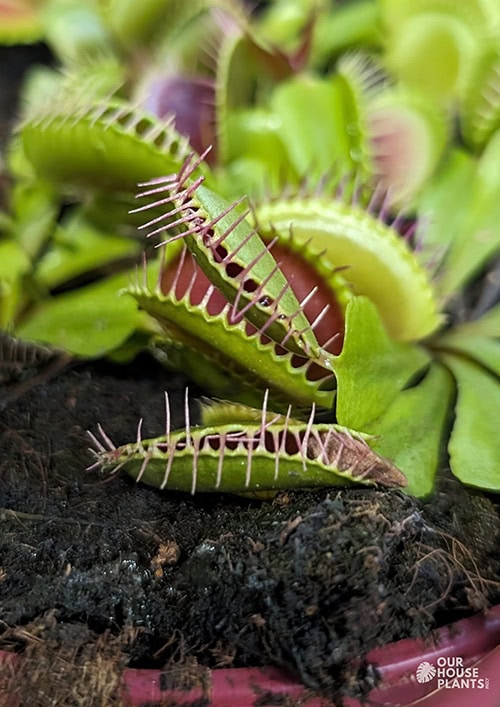
Closed Venus Flytrap traps are usually digesting a meal or recovering after being triggered. Leave them alone rather than trying to force them back open.
Causes
- It's digesting.
Give it up to two weeks. When it reopens you'll see the dried husk of whatever it caught, which will blow away or can be gently removed. - It's caught something too big.
If the trap is discolouring or going soft rather than just staying shut, the contents are rotting. That trap is lost. Snip it off once it's blackened to stop mould getting a foothold. - Don't prise it open.
Whatever's going on inside, forcing it is worse than waiting, as you'll tear or damage it.
Long floppy leaves and tiny traps
You notice the traps are getting smaller with each new one. Or maybe the leaves are stretching out long and thin or they flop over rather than standing up. In these cases it's almost certainly a lighting issue.
Causes
- Not enough direct sun.
This is nearly always the cause and it's the most common mistake people make indoors, because a "bright spot" for your other houseplants is deep shade to a Venus Flytrap. This plant wants at least four hours of direct sun. Move it to a south facing windowsill, or outdoors for the Summer, and the next set of leaves will come through shorter and stronger with bigger traps. The stretched ones won't shrink back, but they'll be replaced in time. - It's just come out of dormancy.
The first leaves of Spring are often a bit weedy. If the light's good they'll bulk up over a few weeks.
Traps aren't red
Yours are green inside, but the photos online all have that deep red glow. What's going on?
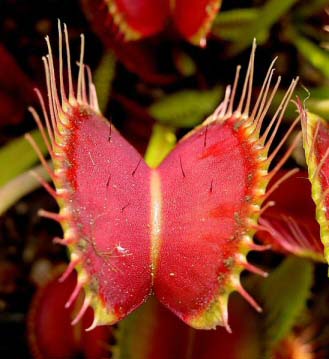
This is what plenty of direct sun looks like. The red is essentially the plant's version of a suntan. Photo by Noah Elhardt
Causes
- Light levels.
The red pigment develops in response to strong sun. A green plant that's otherwise compact and growing well is healthy, it's just not getting quite enough light to colour up. Give it more sun and it'll redden over a few weeks. If it's green and floppy, then light is a real problem rather than a cosmetic one. - It's the variety.
Some cultivars stay all green no matter what you do. If it came without a name, you won't know until you've given it a Summer of sun.
Crispy brown leaf edges
The edges of the leaves and the "teeth" on the traps are going brown and dry, while the rest of the plant looks okay. A little of this on an older trap is normal, especially towards the end of its life. But if it is happening repeatedly on new growth, something needs adjusting.
Causes
- The growing medium dried out.
Venus Flytraps can cope with plenty of water during the growing season, in fact the bottom inch or so of the container can sit directly in water for most of the time. But they do not cope well with drying out. Even one bad dry spell can damage traps that were developing at the time. Keep the medium wet in Spring and Summer, and wait for healthy replacement growth. - Sudden move into full sun.
A plant that's been living somewhere dim and then goes straight onto a blazing windowsill can scorch. The damaged leaves won't recover but new ones will be fine. To avoid this, build up the exposure over a week or so. - Mineral build up.
If you've been using tap water, the salts can collect in the medium and leaf tips are often where the damage starts to show. Flush the pot through with plenty of rainwater and switch permanently if you can. See white crust below. - General root stress.
Old, compacted growing medium, or a pot that has become completely full of roots, or a recent rough repot with careless handling can all make new traps look a bit tatty for a while. If the plant has been in the same medium for a couple of years, repot it in Spring using a proper carnivorous plant mix.
Grey fuzzy mould
A grey, fluffy growth appearing on blackened traps, old leaves or the surface of the medium. This is botrytis, or grey mould, and it's almost always a winter problem.
Causes
- Cold, damp and still air.
The mould loves these conditions and it can quickly do serious damage and take over your plant. This can be a real problem if you are storing your plant in a garage or shed over Winter, so it's worth checking your plant every few week during this period. - The fix.
Pick or snip off all the old, blackened leaves and traps (this is the one time I'd say tidy the plant up properly). Move it somewhere with a bit more air movement and light, even if that's just cracking a window occasionally. Ease off the watering so the medium is damp rather than wet. The tidy up and airflow usually sort it. If it keeps returning or starts spreading onto healthy growth, isolate the plant and seek advice from a carnivorous plant specialist before using any fungicide. (I've had small amounts of mould on my plants over the years, but nothing too serious so I've never had to use any sprays).
White crust on the soil or pot
A chalky white or off-white deposit on the surface of the growing medium, around the rim of the pot or on the drip tray. It's a bit like the scale you get in a kettle, and it's there for the same reason.
Causes
- Tap water.
Every time you water with tap water the dissolved minerals stay behind when the water evaporates. This crust is the visible bit. The invisible bit is what's building up around the roots and slowly damaging the plant. If you see this, the water is often the problem. - The fix.
Flush the pot through several times with rainwater or distilled water to wash out what you can. If the crust is heavy or the plant is clearly suffering, repot into fresh carnivorous mix and give the pot a good scrub.
Going forward Rainwater is the simplest choice for most people. Distilled water, deionised water or reverse-osmosis water also work. Tap water is only suitable long term if you know it is very low in dissolved minerals, so if you are unsure, maybe don't risk it!
Pests
You'd think a plant that eats insects would be the last to have a pest problem, and to be fair it's rarely a big one. But a few things do turn up, especially on plants kept indoors year round or brought in from outside.
Causes
- Aphids.
Tiny green or black insects clustered on the new growth in the centre of the plant. They cause the new leaves to come through twisted and deformed and are too small to be caught by the traps. First, rinse the plant gently and remove what you can by hand. For stubborn clusters, wipe them carefully with a cotton bud dipped in 70% isopropyl alcohol, keeping it off the growing medium and rhizome as much as possible. Repeat a week later for any you missed. - Mealybugs.
Look for small white cottony blobs tucked down at the base of the leaves where they meet the rhizome. A cotton bud with 70% isopropyl alcohol dabbed directly on each one is the most effective way I've found. Check every few days for a couple of weeks because the Mealies you can see are never the whole story. - Fungus gnats.
Little black flies hovering around the pot. They love the constantly wet growing medium, which makes Venus Flytraps an easy target for them. The adults are mostly a nuisance and the traps will happily eat a few, but heavy infestations can mean larvae are living around the roots. Don't solve it by letting the plant dry out, as that creates a worse problem for the plant. Use yellow sticky traps nearby to reduce the adults and, if numbers stay high, replace the old growing medium with fresh carnivorous plant compost. - A word on sprays.
Go carefully with general purpose insecticides and Neem oil on Venus Flytraps, they can react badly. Spot treatment with alcohol or manual removal is gentler and you should still get good results.
Declining a few weeks after you bought it
It looked perfect in the shop, but two or three weeks at home and it's losing traps, not closing or generally looking sorry for itself. This is the classic Venus Flytrap experience and it's why so many owners think they simply can't be grown indoors.
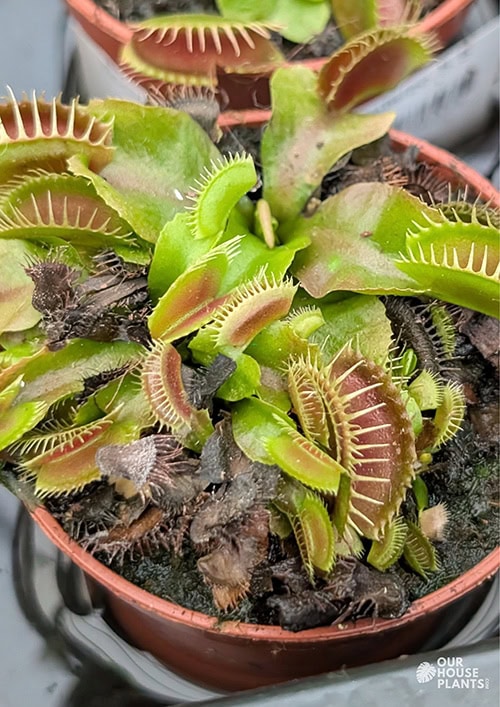
A Venus Flytrap can look rather sorry for itself after coming home from the shop. Give it strong direct light, mineral-free water and time to settle before writing it off.
Causes
- It's been through a lot.
Grown in a greenhouse under ideal conditions, packed in a box, stuck on a shelf in a supermarket for a fortnight under fluorescent lights, watered with tap water (or not at all), then brought home to yet another new environment. Some shock and adjustment is almost guaranteed. As long as new growth appears from the centre within a few weeks of settling in, it's recovering. - It's being treated like a normal houseplant.
Bright indirect light, tap water and a bit of plant food are no-no's for this one. Check it against the golden rules in my care guide and fix whichever one you've missed. - It came in normal compost.
Most reputable sellers use a proper carnivorous mix, but not all. If the pot contains anything that looks like standard dark potting compost, repot it straight away into peat or sphagnum and perlite. - It arrived in Autumn.
If you bought it late in the year it may simply be heading into dormancy right on schedule. Frustrating timing, but not a problem.
About the Author
Over the last 20 years, Tom has successfully owned hundreds of houseplants and is always happy to share knowledge and lend his horticulture skills to those in need. He is the leading content writer for the OurHouseplants Team.